Meccano
Dave Prout will be presenting a talk on Meccano - a brand of model construction system introduced.
It was created in 1898 by Frank Hornby in Liverpool, England. The system consisted of reusable mechanical parts. {Wikipedia}
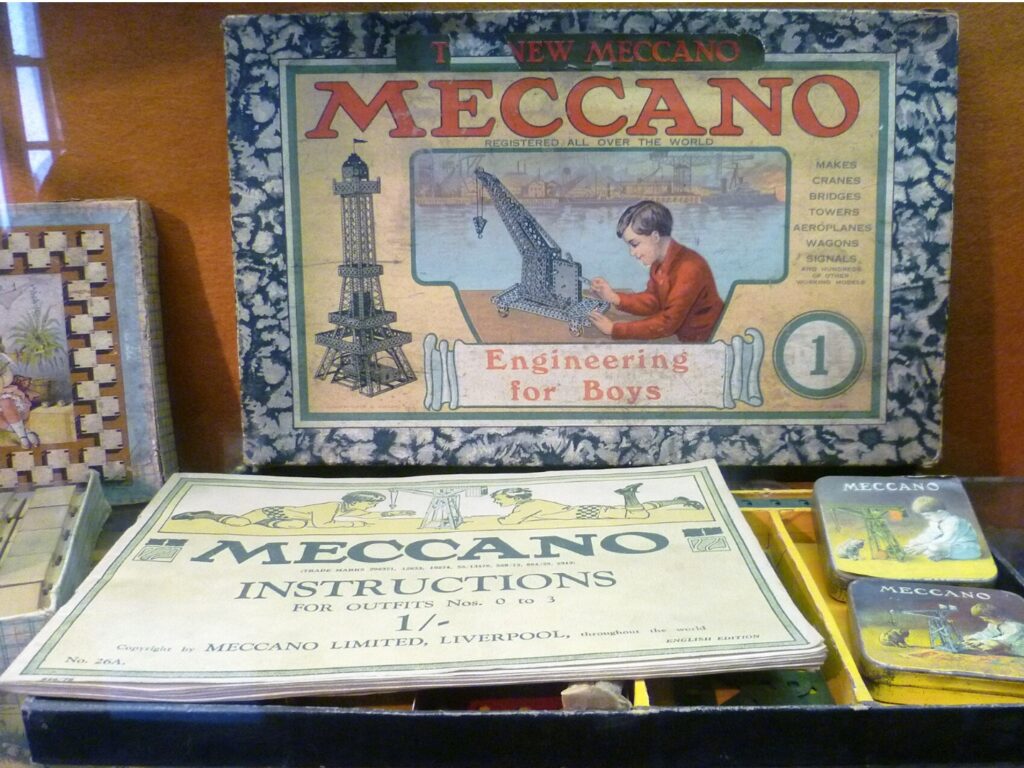
A Sexist advertising approach? Tsk tsk!
Not that we are sexist, but the strapline against this ad was "Give your boy Meccano this Christmas". Meccano was based on mechanical engineering principles, comprising sets of plates; jointing pieces; girders; nuts; bolts; springs; drive cord; cranks; gears a-plenty; axles and wheels.
The instruction books provided copious assembly details and it was possible (usually for Dad) to spend many happy hours building complex mechanical entities.
Motive power was provided by means of a large clockwork mechanism, although later Meccano sets added the luxury of an electric motor. two tools were provided: A slotted screwdriver and a spanner for tightening awkwardly placed square nuts
So popular was Meccano that demand heavily outstripped supply, and having started through third party factories, Frank Hornsby quickly opened his own factory in Liverpool
The history of model train sets is highly complex, both pre and after World War II. In the UH the pre-eminent (and highly expensive) manufacturer was Basset Lowke.
Frank Hornby soon introduced model trains to complement his construction toy. His first foray was the so-called "0" gauge. The "0" scale actually differed from country to country - varying between 1:43.5 to 1:48. Care needed: don't confuse SCALE with GAUGE. {See Wikipedia https://en.wikipedia.org/wiki/O_scale }
"0" gauge trains were classed as toys and were initially powered by clockwork, but later by electricity - in the case of the USA a rather dangerous 110 volts. By the '50s Hornby had introduced the smaller "00" gauge - powered by a sensible low voltage and running on a 3 rail system.
Hornby found strong competition from the German Trix Twin system and Triang Toys